

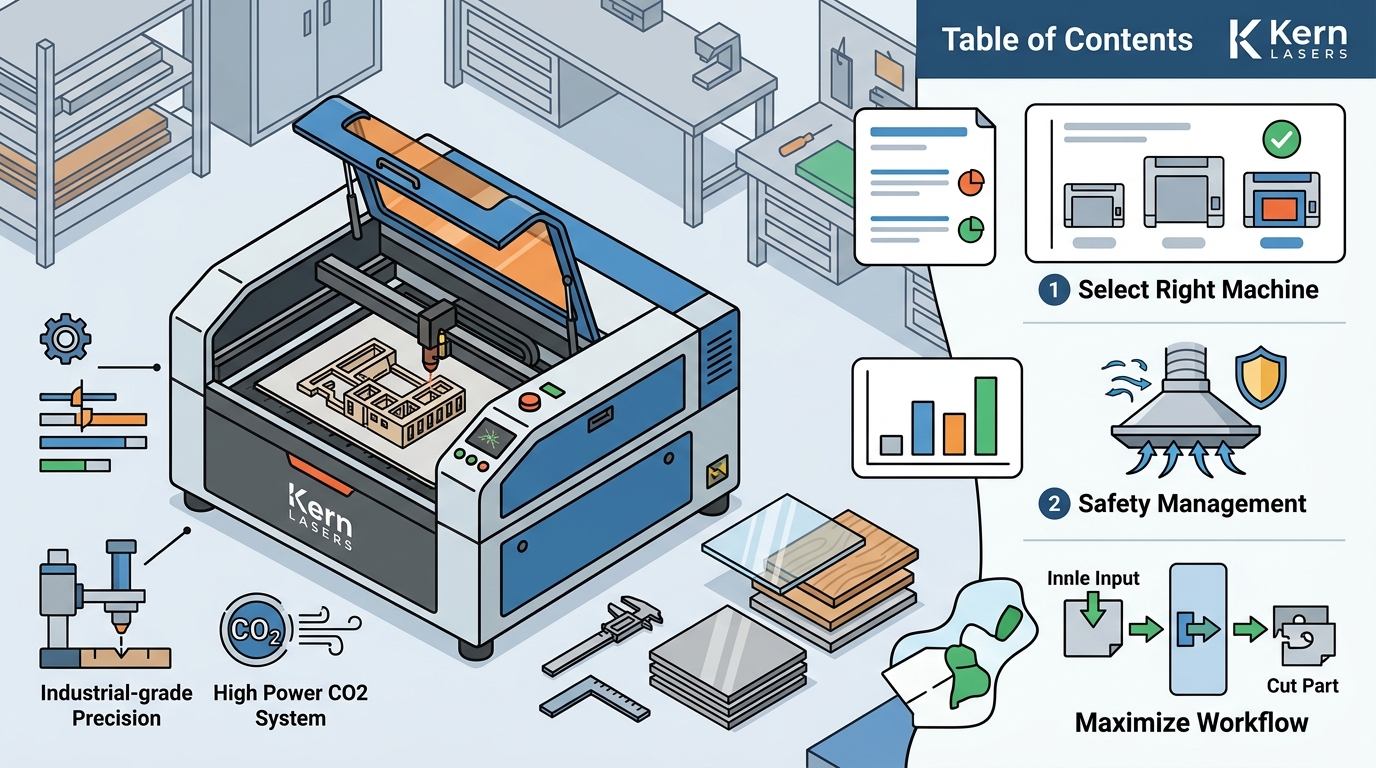
For a shop with limited space, the best small laser cutter is a compact, high-power CO2 system like the Kern MICRO. It delivers industrial-grade precision in a small footprint without sacrificing output. This guide covers how to select the right compact machine, manage safety in tight quarters, and maximize workflow efficiency.
Compact Laser Cutters
Defining the Footprint
When evaluating space, look at the total floor area required, including room for material handling. A standard large-format machine might require 10 feet of clearance, which is often impossible in a small shop. Compact systems, such as the Kern MICRO, are engineered to fit into tighter spaces. These systems often feature a smaller bed size, which allows them to sit on a standard workbench or in a corner of a room. This design choice is critical for shops that need to keep other equipment nearby.
Power and Material Versatility
Size does not have to mean low power. A compact laser cutter is often equipped with the same high-quality CO2 laser sources as larger machines. For example, the MICRO system can be equipped with powerful CO2 lasers that handle a wide range of materials. You can cut wood, acrylic, and light metals with a small machine. This versatility is essential for a small shop that might take on diverse jobs, from engraving awards to cutting small parts for prototyping. By choosing a compact system with high wattage, you ensure that you are not limited to thin materials or slow processing speeds.
Workflow and Ergonomics
In a small space, ergonomics and workflow are just as important as the machine itself. A compact laser cutter is easier to access from all sides, which simplifies loading and unloading. You do not need a forklift or a large team to move a sheet of material onto the bed. This ease of use reduces the physical strain on operators and speeds up the production cycle. Additionally, compact systems often have a lower profile, which can help with ventilation and fume extraction in a small room. Proper fume management is a safety requirement, and a smaller machine is easier to duct out of a limited space.
| Feature | Compact Laser Cutter | Large Format Laser Cutter | |||
|---|---|---|---|---|---|
| Footprint | Small, fits on a workbench | Large, requires dedicated floor space | |||
| Material Handling | Manual, easy access | May require assistance or equipment | |||
| Power | High, suitable for production | High, suitable for heavy production | Versatility | High, good for diverse jobs | High, good for large sheets |
| Best For | Small shops, prototyping, engraving | Large production runs, full sheets |
The choice between a compact and a large format system depends on your specific needs. If you are working with full sheets of material, a large format machine is necessary. However, if you are working with smaller parts or need to maximize your floor space, a compact system is the better choice. The Kern Laser Systems lineup includes options for both, allowing you to select the right size for your shop.
Key Takeaways
- A compact laser cutter is a machine designed for small footprints with high power.
- Compact systems are easier to load and unload in tight spaces.
- High wattage is essential for cutting a variety of materials in a small machine.
- Fume extraction is easier to manage with a smaller, lower-profile machine.
- Choosing the right size depends on your material size and workflow needs.
- Kern Laser Systems provides support and training for all their compact models.
Frequently Asked Questions
What is the smallest laser cutter that can cut metal?
The Kern MICRO can be equipped with a metal cutting package. This allows it to cut light gauge metals like aluminum and stainless steel. The compact size does not limit the metal cutting capability of the machine.
Is a small laser cutter safe for a small room?
Yes, provided you follow safety protocols. You must have proper fume extraction and a Laser Safety Officer. The enclosed models, like the LaserCELL, are Class 2 and safer for small spaces.
Can I upgrade a small laser cutter later?
Yes, many compact systems can be upgraded with new lenses, rotary attachments, or higher power sources. This allows you to expand your capabilities as your business grows.
What materials can a compact laser cutter process?
Compact CO2 lasers can process wood, acrylic, leather, foam, and light metals. Fiber lasers can process metals. The specific materials depend on the laser source and power.
How much space do I need for a compact laser cutter?
You need enough space for the machine itself, plus room for material handling and ventilation. A compact system like the MICRO requires less floor space than a large format machine.
Does Kern Laser Systems offer financing for small lasers?
Yes, Kern offers financing options to help you purchase the right equipment for your budget. You can contact their team to discuss financing plans.
What is the difference between a compact and a large format laser?
The main difference is the bed size and footprint. Compact lasers have smaller beds and fit in tighter spaces. Large format lasers have larger beds for full sheets of material.
Can I use a compact laser for engraving?
Yes, compact lasers are excellent for engraving. They offer high precision and detail, which is ideal for awards, signage, and custom products.
Conclusion
Selecting the right laser for a small shop is a strategic decision. A compact laser cutter offers the power and versatility you need without consuming your entire floor space. The Kern MICRO is a prime example of a system that balances size with performance. By choosing a machine that fits your space and your materials, you can maximize your productivity and grow your business. To find the right system for your shop, contact Kern Laser Systems today.