
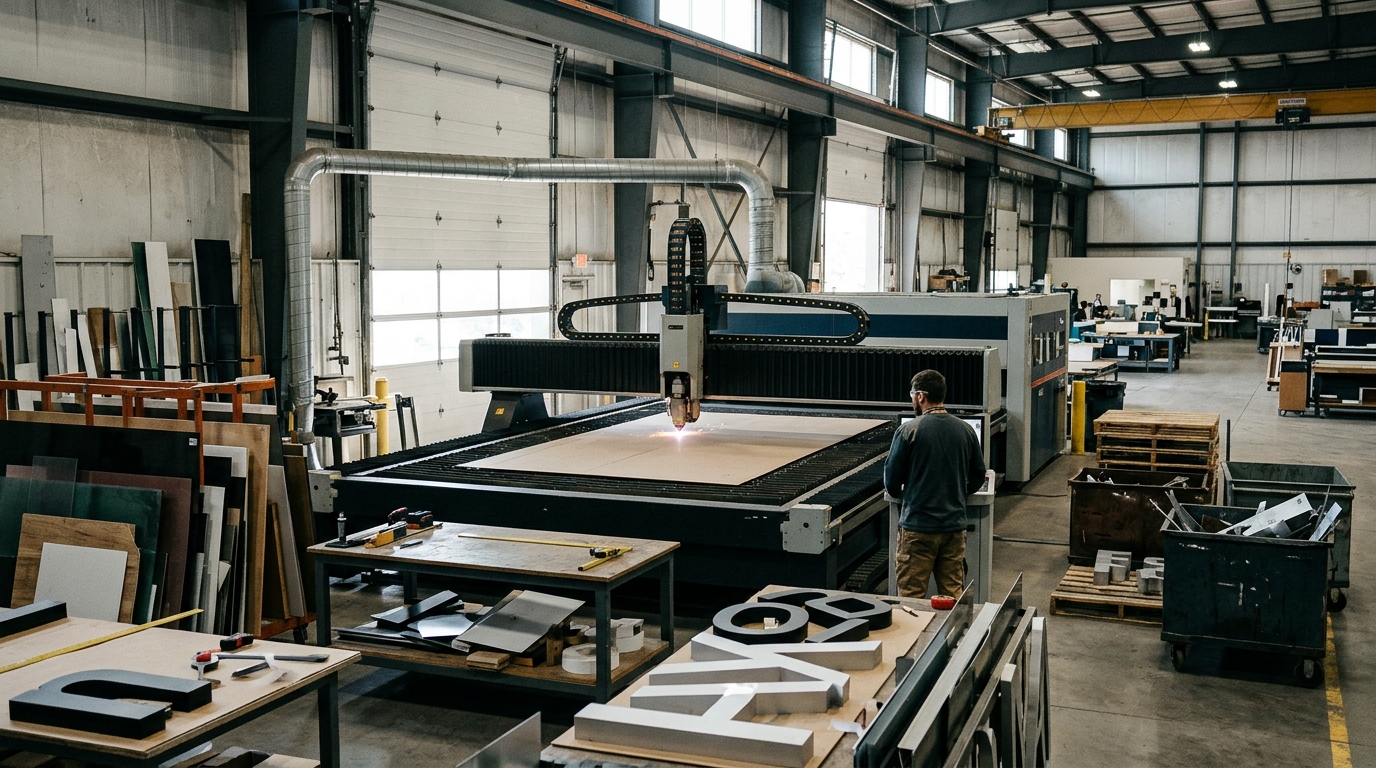
Before purchasing a Kern laser system for your sign shop, you must evaluate your specific material mix, required bed size, and safety compliance needs. Kern Laser Systems, founded in 1982, manufactures large format CO2 and fiber laser equipment in Wadena, Minnesota. These machines are engineered for high-volume production environments where precision and uptime are critical. Understanding the distinct capabilities of their CO2 and fiber platforms ensures you select the right tool for your commercial signage workflow.
Choosing Between CO2 and Fiber Laser Sources
The primary decision for a sign shop is selecting the correct laser source. A CO2 laser is a gas-based laser system that excels at cutting non-metals like acrylic, wood, and foam, as well as light gauge metals. A fiber laser is a solid-state laser system that is significantly more efficient and faster for cutting reflective metals such as stainless steel and aluminum. For a sign shop that primarily produces acrylic channel letters or wood inlays, a CO2 system is the standard choice. If your shop frequently fabricates metal signs or requires high-speed metal cutting, a fiber laser is the superior option.
Kern offers both technologies in their product lineup. The OptiFlex is a high-performance large format system that can be configured with either a CO2 or fiber source. The FiberCELL is an enclosed metal cutting system designed specifically for fabrication. By understanding the wavelength differences, you can avoid buying a machine that cannot efficiently process your primary materials.
System Classifications and Safety Protocols
Safety is a non-negotiable aspect of industrial laser operation. A Class 4 laser is a high-power laser system that requires strict safety controls, including a designated Laser Safety Officer (LSO) and protective eyewear. Kern’s open-bed systems, such as the OptiFlex and EcoFlex, are Class 4 machines. Their enclosed systems, like the LaserCELL and FiberCELL, are Class 2 machines, which do not require safety glasses for normal operation due to their enclosed design. Understanding these classifications is vital for your facility planning and insurance compliance.
Kern’s engineers design their equipment to meet or exceed safety standards set by CDRH, UL, CE, and ANSI. For open-bed systems, you must appoint an LSO to monitor safe usage and define control measures. This includes assigning proper laser safety glasses and implementing safe operational procedures. The Laser Institute of America offers training courses for those looking to become an LSO. Proper safety planning prevents accidents and ensures a healthy working environment for your staff.
Software Control and Material Registration
Hardware is only half the equation; software control determines your operational efficiency. KCAM is a proprietary laser control software developed by Kern’s in-house team. It allows operators to adjust material settings, system parameters, and cut paths with precision. The software includes a built-in time estimator, which is a valuable tool for quoting jobs accurately. For sign shops working with preprinted materials, the K-Vision camera registration package is a critical add-on.
The K-Vision system uses a nozzle-mounted camera to measure registration marks on preprinted sheets. It automatically compensates for distortion and rotation, ensuring a perfectly matched cutout. This is essential for high-end signage where print alignment must be exact. KCAM connects with popular design software like Adobe Illustrator and CorelDRAW via a PDF Converter Tool. This integration streamlines the workflow from design file to finished sign, reducing manual errors and setup time.
Material Capabilities and Application Specifics
Sign shops process a wide variety of substrates, and not all lasers handle them equally. Kern’s CO2 lasers are ideal for cutting acrylic with a flame-polished edge quality. They also excel at engraving frosty white marks on glass and acrylic for LED etched signs. For wood products, such as inlays or custom displays, CO2 lasers provide clean cuts with minimal waste. The vacuum hold-down table keeps sheets flat during processing, while the blower system removes fumes and debris.
For metal signage, the metal cutting package includes an Automatic Focusing Height Follower. This device uses a capacitance sensor to track the metal surface and maintain a constant focus point. It ensures a dross-free cut, eliminating the need for secondary deburring. Kern’s systems can also process foam for tool shadowing or protective cases, which is useful for shops that create custom packaging or displays. Testing your specific materials is recommended before finalizing a purchase to ensure optimal cut quality.
Support, Warranty, and Long-Term Value
Long-term reliability is a key factor in the total cost of ownership. Kern Laser Systems provides a 3-year warranty on CO2 laser sources, which is a significant advantage in the industry. The company is proudly manufactured in the USA, with a modern 90,000 sq. ft. facility in Minnesota. This domestic manufacturing ensures quality control and easier access to parts and support. Kern’s customer support team includes experienced technicians who can assist with troubleshooting and maintenance.
The company also offers a collaborative manufacturing service, allowing customers to access excess laser capacity if needed. This can be a safety net for shops facing peak production periods or labor shortages. By choosing a manufacturer with a strong support infrastructure, you protect your investment and ensure minimal downtime. Kern’s commitment to customer service is reflected in their detailed manuals, training videos, and responsive support channels.
Key Takeaways
- CO2 lasers are best for non-metals and light gauge metals, while fiber lasers are superior for reflective metals.
- Class 4 open-bed systems require a Laser Safety Officer and strict safety protocols.
- KCAM software provides essential controls, including time estimation and material parameter adjustment.
- The K-Vision camera package is critical for accurate cutting of preprinted signage materials.
- Kern offers a 3-year warranty on CO2 laser sources and is manufactured in the USA.
- Testing your specific materials before purchase ensures optimal cut quality and workflow efficiency.
Frequently Asked Questions
What is the difference between a Class 2 and Class 4 laser?
A Class 2 laser is a low-power laser system that is safe for normal operation without protective eyewear, typically found in enclosed machines. A Class 4 laser is a high-power laser system that requires strict safety controls, including a Laser Safety Officer and protective glasses, typically found in open-bed machines.
Can Kern lasers cut preprinted materials accurately?
Yes, Kern offers the K-Vision camera registration package. This system uses a nozzle-mounted camera to measure registration marks and automatically compensates for distortion and rotation, ensuring a perfectly matched cutout on preprinted materials.
What software is included with Kern laser systems?
Kern systems include KCAM, a proprietary laser control software. It allows operators to adjust material settings, estimate run times, and control the cutting process. It also connects with popular design software like Adobe Illustrator and CorelDRAW.
Does Kern offer support for metal cutting?
Yes, Kern offers fiber laser systems and metal cutting packages for CO2 systems. The metal cutting package includes an Automatic Focusing Height Follower and programmable air assist to ensure dross-free cuts on metals like stainless steel and aluminum.
Where are Kern laser systems manufactured?
Kern Laser Systems are proudly manufactured in the USA. The company is headquartered in Wadena, Minnesota, where they design and build their industrial laser cutting and engraving equipment.
What is the warranty on Kern CO2 laser sources?
Kern Laser Systems provides a 3-year warranty on CO2 laser sources. This warranty covers the laser source, which is a critical component of the system, ensuring long-term reliability and performance.
Next Steps for Your Sign Shop
Selecting the right laser system is a significant investment in your sign shop’s future. By understanding the differences between CO2 and fiber sources, safety classifications, and software capabilities, you can make an informed decision. Kern Laser Systems offers a range of machines tailored to various production needs, from entry-level to high-performance large format systems. To determine the best fit for your specific materials and workflow, consider testing your materials with a Kern representative. You can test your material to see how a Kern laser performs on your specific substrates. This hands-on approach ensures you are confident in your purchase and ready to scale your production capabilities.