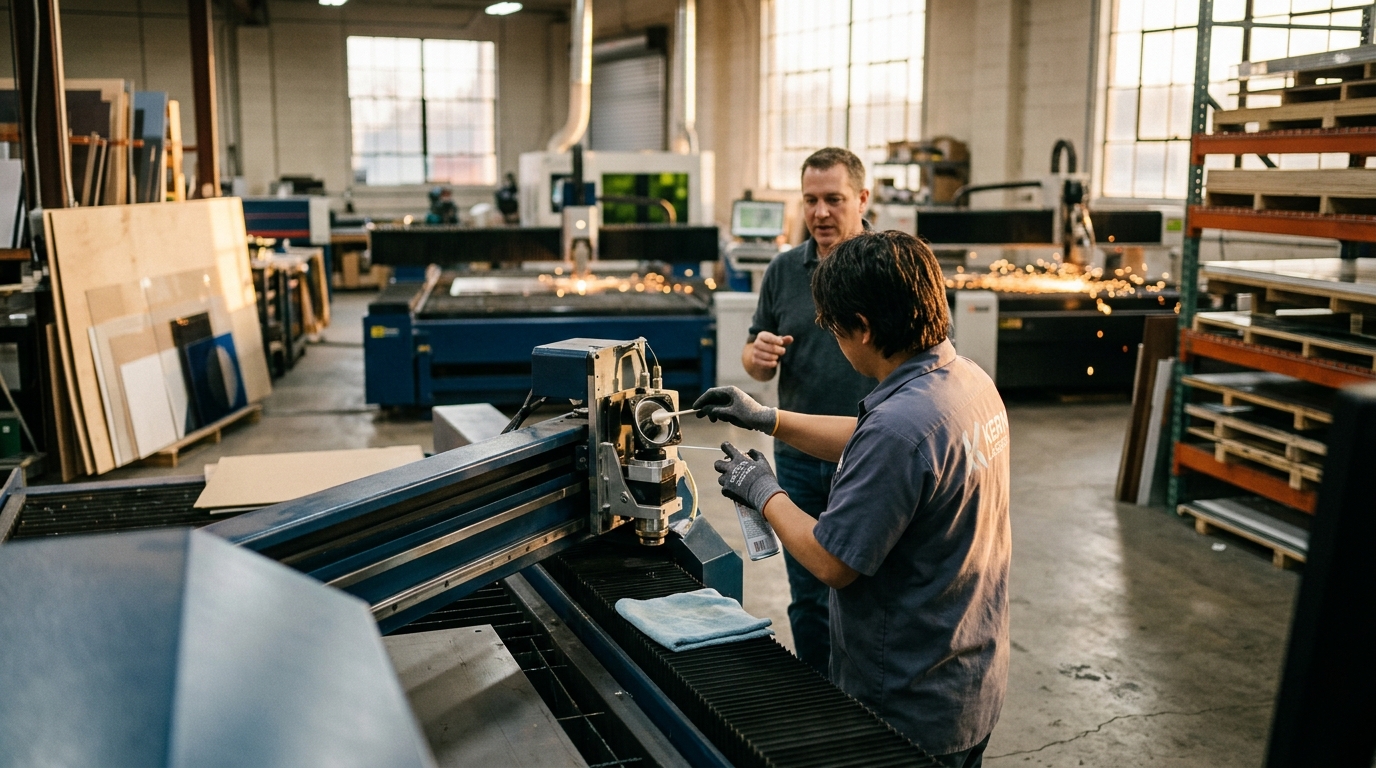
Industrial laser cutting systems represent a significant capital investment for modern manufacturing facilities. According to recent industry data, regular maintenance can extend the operational lifespan of CO2 and fiber laser sources by up to 40%, directly impacting return on investment. Neglecting these protocols leads to costly downtime and reduced cutting precision. This guide outlines the essential maintenance procedures for high-performance laser cutting equipment, drawing on decades of manufacturing expertise.
OptiFlex System Maintenance Protocols
The OptiFlex is Kern’s most popular large format laser cutting and engraving system. It is designed for versatility, processing metal, acrylic, wood, textiles, and foam. Because it handles diverse materials, its maintenance requirements are rigorous. A large format CO2 laser cutter requires consistent optical alignment to maintain beam quality.
Optical Component Inspection
Optical components are the heart of any CO2 laser system. Optical components are the critical elements that focus and direct the laser beam onto the material surface. Dust from cutting acrylic or wood can accumulate on mirrors and lenses. This accumulation causes heat buildup and potential cracking. Daily inspection of the output window is mandatory. Weekly cleaning of internal mirrors with appropriate solvents ensures optimal power delivery.
Chiller and Cooling Systems
Thermal management is vital for high-performance equipment. The chiller maintains the laser source at a stable temperature. Fluctuations in temperature can cause beam instability and reduce cutting speed. Water quality in the chiller must be monitored regularly. Distilled water is required to prevent mineral deposits. Filter changes should occur every three to six months depending on usage intensity.
Motion System Lubrication
The OptiFlex features a high-speed motion system. Linear guides and rails require regular lubrication to prevent wear. Kern designs its systems for durability, but mechanical parts still need attention. Grease points should be checked weekly. Excessive friction leads to positional errors and reduced accuracy in complex cuts.
FiberCELL Metal Cutter Care
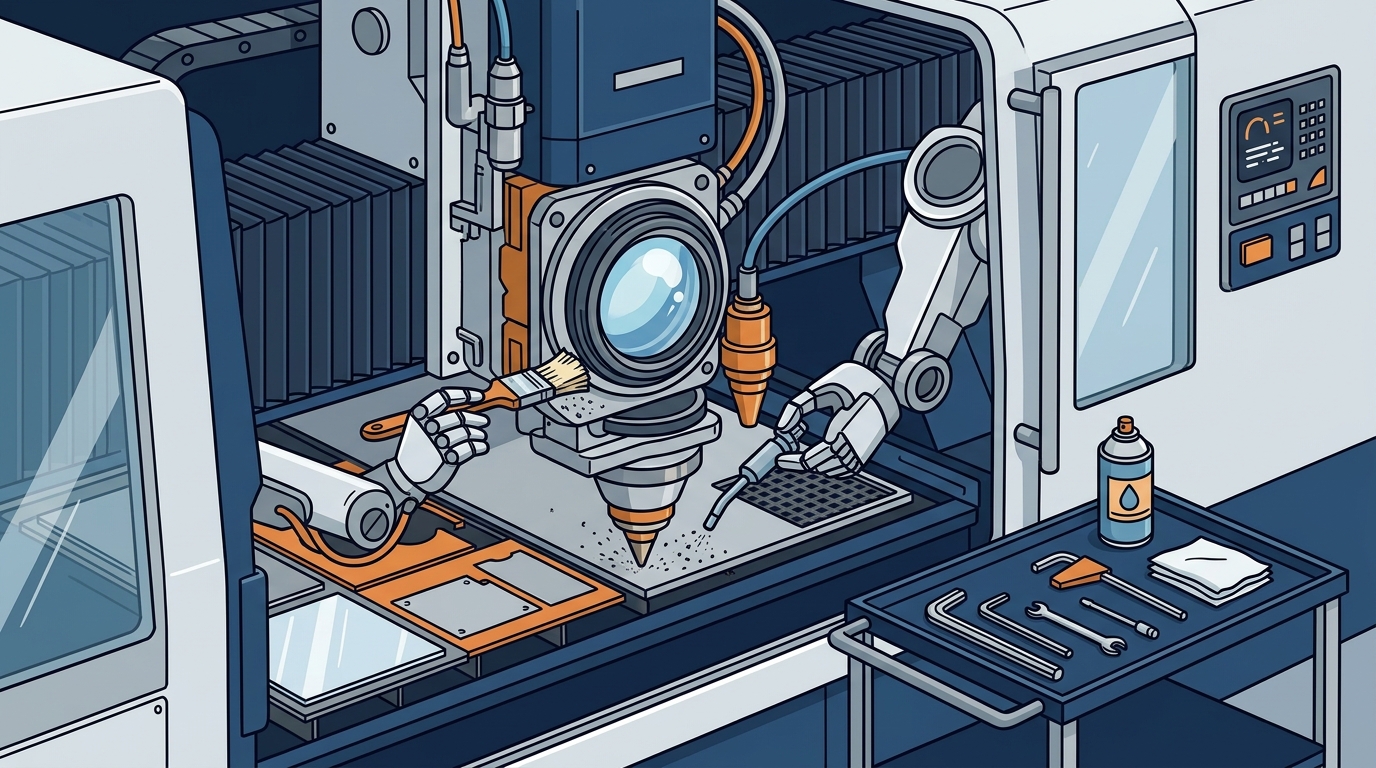
The FiberCELL is a compact sheet metal cutting laser. It cuts stainless steel, mild steel, aluminum, brass, and copper. Unlike CO2 systems, fiber lasers have different maintenance needs. The primary difference lies in the laser source and the cutting head.
Fiber Source Integrity
Fiber laser sources are sealed and require minimal maintenance compared to CO2 tubes. However, the delivery fiber must be protected. Contamination at the cutting head can damage the source. Air assist systems must be kept clean and dry. Moisture in the air line can cause condensation inside the cutting head. This condensation leads to lens damage and erratic cutting performance.
Nozzle and Lens Management
The cutting nozzle directs the assist gas. It must be centered perfectly to ensure a clean cut. Nozzles wear out over time, especially when cutting thick metals. Regular replacement prevents back-reflection damage. The focus lens must be cleaned after every shift. Spatter from metal cutting adheres quickly to optics. A dirty lens alters the focal point and reduces cutting efficiency.
K-Vision Camera System
Kern’s K-Vision camera registration system aligns the laser with preprinted materials. This system requires regular calibration. Dust on the camera lens can cause alignment errors. The camera must be wiped clean daily. Software updates for K-Vision should be installed promptly to ensure compatibility with new file formats.
KCAM Software and Calibration
KCAM Laser Software controls the entire cutting process. It manages motion, power, and speed parameters. Software maintenance is often overlooked but is equally important. Regular backups of job files and settings are essential.
Software Updates and Patches
Kern releases updates to improve performance and fix bugs. These updates should be applied during scheduled downtime. Updating ensures that the machine utilizes the latest optimization algorithms. Outdated software can lead to inefficient cutting paths and increased material waste.
Parameter Optimization
Different materials require different cutting parameters. Kern provides standard settings for common materials. However, operators should optimize these settings for specific batch runs. Documenting successful parameters for each material type creates a valuable reference library. This practice reduces setup time and improves consistency.
Safety Enclosure and Class 2 Standards
Safety is a paramount concern in laser operations. Kern’s LaserCELL and FiberCELL systems feature fully enclosed Class 2 safety enclosures. These enclosures protect operators from laser radiation and flying debris.
Enclosure Integrity Checks
The safety interlocks on the enclosure doors must function correctly. These interlocks cut power to the laser source when the door is opened. Testing these interlocks weekly is a critical safety procedure. Any malfunction must be addressed immediately by qualified personnel. Never bypass safety interlocks under any circumstances.
Ventilation and Filtration
Laser cutting generates fumes and particulates. The ventilation system must be robust enough to handle these byproducts. Filters in the ventilation system should be replaced regularly. Clogged filters reduce airflow and can cause hazardous fume buildup in the workspace. Proper ventilation protects both the equipment and the operators.
Fire Prevention Measures
Lasers generate intense heat. Fire suppression systems should be installed near the machine. Operators must be trained in fire safety procedures. Keeping a fire extinguisher nearby is a basic requirement. Regular inspection of the work area for combustible materials is also necessary.
Warranty and Support Frameworks
Kern Laser Systems stands behind its products with comprehensive support. The company offers a 3-year warranty on CO2 laser sources. This warranty reflects confidence in the quality of their super pulsed high-quality laser sources.
Warranty Coverage Details
The warranty covers defects in materials and workmanship. It does not cover damage caused by misuse or lack of maintenance. Proper maintenance records are essential for warranty claims. Operators should document all cleaning and inspection activities. This documentation proves that the equipment was cared for according to specifications.
Technical Support Access
Kern provides technical support for troubleshooting and guidance. Customers can access support through the website or by phone. The support team is knowledgeable about all Kern systems. They can assist with software issues, hardware problems, and material testing.
Training and Education
Kern offers training for new operators. Training covers safety, operation, and maintenance. Proper training reduces the risk of accidents and equipment damage. Operators who understand the machine are more likely to maintain it correctly. Kern encourages customers to utilize these resources.
Key Takeaways
- Optical Care: Daily inspection and weekly cleaning of mirrors and lenses are critical for CO2 systems like the OptiFlex.
- Fiber Source: Fiber lasers like the FiberCELL require less source maintenance but demand strict air assist cleanliness.
- Software: Regular updates to KCAM Laser Software ensure optimal performance and compatibility.
- Safety: Class 2 enclosures and interlocks must be tested weekly to ensure operator safety.
- Warranty: Kern offers a 3-year warranty on CO2 sources, contingent on proper maintenance documentation.
- Chiller: Thermal management via distilled water and filter changes prevents laser source damage.
- Support: Kern provides extensive technical support and training to maximize equipment lifespan.
Frequently Asked Questions
How often should I clean the laser optics?
Optics should be inspected daily and cleaned weekly for CO2 systems. Fiber laser cutting heads require cleaning after every shift due to metal spatter.
What type of water is required for the chiller?
Distilled water is required to prevent mineral deposits. Tap water can cause scaling and damage the laser source.
Is the FiberCELL suitable for high-traffic areas?
Yes, the FiberCELL features a Class 2 safety enclosure, making it safe for use in busy factory floors and classrooms.
What is the warranty period for CO2 laser sources?
Kern offers a 3-year warranty on its CO2 laser sources. This warranty covers defects in materials and workmanship.
How does K-Vision improve cutting accuracy?
K-Vision uses a camera registration system to align the laser with preprinted materials. This ensures precise cutting and engraving.
Can I cut metal with the OptiFlex?
Yes, the OptiFlex is capable of processing metal, along with acrylic, wood, textiles, and foam.
Where is Kern Laser Systems located?
Kern Laser Systems is headquartered in Wadena, Minnesota, USA. The company manufactures its equipment in the Midwest.
Schedule Your Maintenance Consultation
Proper maintenance is the key to maximizing the lifespan and performance of your laser cutting equipment. Kern Laser Systems is committed to providing the best customer service in the laser industry. Contact us today to learn more about our maintenance services and support options. Visit our Contact Page to request a quote or speak with a specialist. Explore our Blog for more technical insights. Discover the About Kern story and our dedication to quality. Review our Applications to see how our machines can transform your production. Access KCAM Software resources for advanced control. Check our Laser Cutting guides for best practices. Manage your account via the Customer Login portal.