
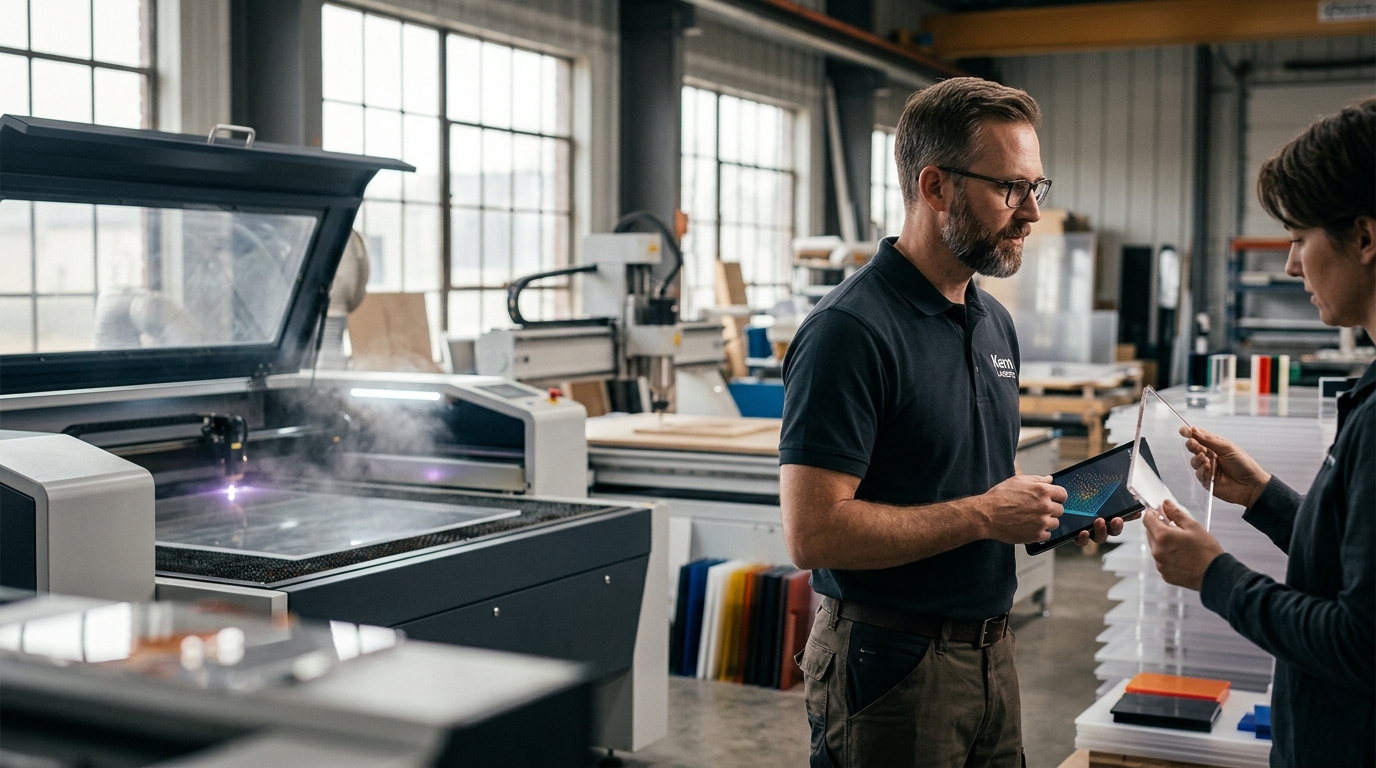
Choosing the right manufacturing technology for large-scale acrylic production is a critical decision that impacts both product quality and operational profitability. Thermoplastic processing data indicates that laser cutting offers superior edge quality for complex geometries, while CNC routing provides faster cycle times for simple, high-volume shapes. Understanding the mechanical differences between these methods is essential for facility managers aiming to optimize their workflow. (Kern Customer Login Area)
Understanding the Technology
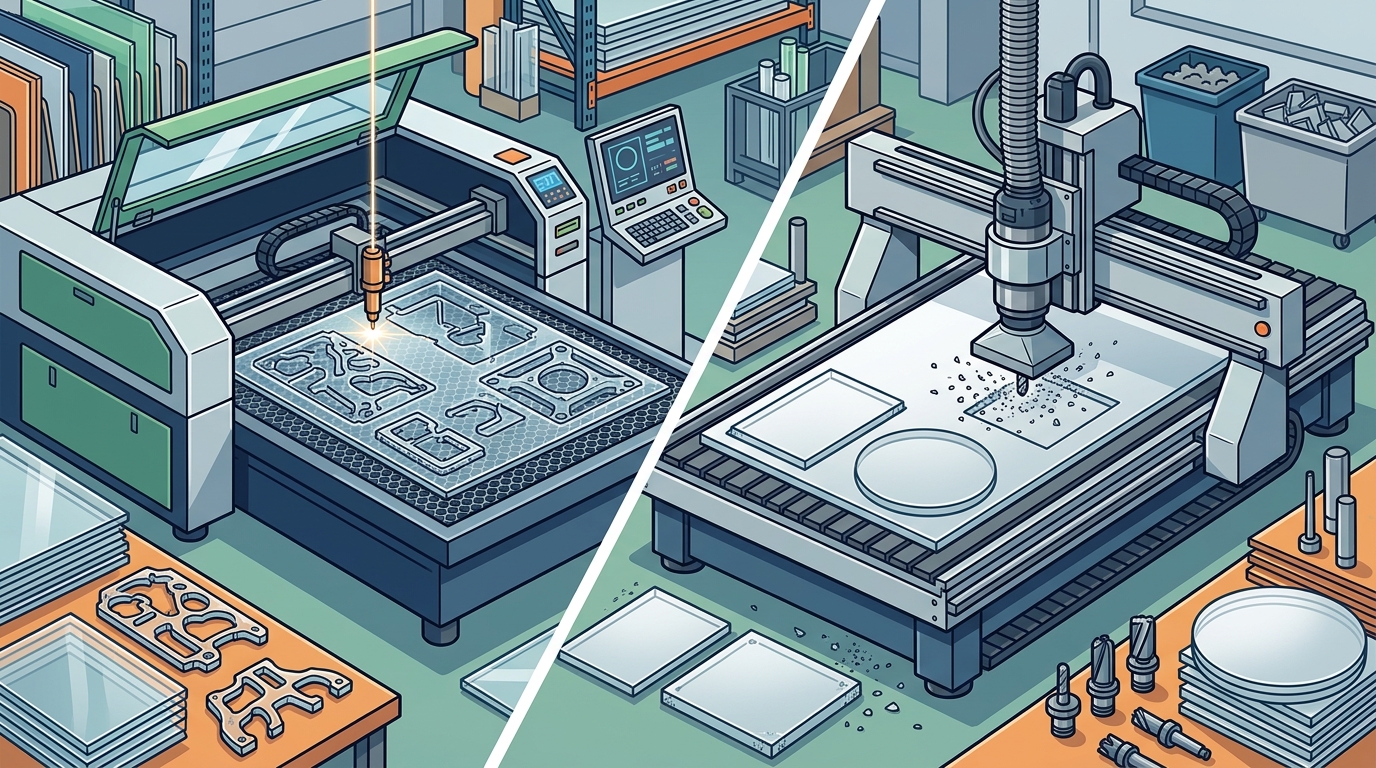
At the core of this decision lies the fundamental difference in how each machine interacts with acrylic. Laser cutting utilizes a high-intensity beam to melt and vaporize material, creating a seamless cut without physical contact. This process is governed by the principles of laser cutting physics, where the beam focus determines the kerf width and edge polish. In contrast, a CNC router uses rotating physical bits to mechanically remove material. This mechanical action requires significant force, which can lead to chipping or cracking in large, brittle sheets of acrylic. (About Kern Laser Systems)
Kern Laser Systems has specialized in large format laser cutting since 1982, focusing on delivering precision and versatility for industrial applications. Their systems, such as the OptiFlex, are designed to handle the thermal dynamics of acrylic with minimal stress on the material. This heritage of manufacturing in the USA ensures that their machines meet rigorous industrial standards for consistency and durability. (Laser Cutting and Laser)
Edge Quality and Finish
For large-scale acrylic production, the final appearance of the cut edge is often the primary quality metric. Laser cutting produces a naturally polished, glass-like edge that requires little to no post-processing. This is particularly valuable for architectural signage and high-end displays where clarity and aesthetics are paramount. The heat-affected zone in laser cutting is minimal when parameters are correctly set, preventing the yellowing or clouding that can occur with improper cooling. (Large Format Laser Cutting)
Conversely, CNC routers leave a machined surface that typically requires secondary finishing. This may involve flame polishing, sanding, or chemical smoothing to achieve a transparent look. While flame polishing can restore clarity, it adds time and labor costs to the production cycle. Furthermore, the mechanical stress from router bits can cause micro-fractures in large sheets, which may compromise the structural integrity of the final product.
Material Efficiency and Waste
Material utilization is a significant factor in large-scale operations. CNC routers generally offer better material efficiency for simple geometric shapes because the kerf (cut width) is wider but more predictable. However, for complex, intricate designs, laser cutting often results in less waste due to its narrow kerf and precision. The ability to nest parts closely together on a sheet can reduce raw material costs significantly.
Kern’s large format systems are engineered to maximize the usable area of standard sheet sizes. Their EcoFlex and OptiFlex models provide extensive work envelopes that accommodate large acrylic sheets without the need for multiple smaller cuts. This capability reduces handling time and minimizes the risk of damage during material movement.
Production Speed and Volume
Speed is a critical variable in high-volume production. CNC routers can be faster for simple, straight-line cuts or large, open shapes because the tool can move at high speeds without the thermal lag associated with laser power ramp-up. For example, cutting a large rectangular frame might be completed more quickly with a router than with a CO2 laser.
However, laser cutting excels in complex geometries and fine details. The non-contact nature of the laser allows for rapid changes in direction without the inertia issues faced by router bits. For intricate logos, detailed signage, or complex panel enclosures, a laser system will consistently outperform a CNC router in terms of cycle time and accuracy. The OptiDual system from Kern, for instance, offers dual-laser high production capabilities, further enhancing throughput for demanding environments.
Operational Costs and Maintenance
Operational costs extend beyond the initial purchase price. Laser systems require regular maintenance of optical components, such as mirrors and lenses, as well as gas supplies for CO2 lasers. However, modern fiber laser technology, as seen in Kern’s FiberCELL line, reduces these consumable costs significantly. CNC routers, on the other hand, incur ongoing costs for router bits, which wear down and need frequent replacement, especially when cutting abrasive or hard materials.
Energy consumption is another factor. CO2 lasers can be energy-intensive, but advancements in power supply efficiency have improved their energy profile. CNC routers consume power primarily through their motors and spindles, which can be optimized through variable frequency drives. Overall, the total cost of ownership depends heavily on the specific application, volume, and maintenance practices of the facility.
Comparison Summary
| Feature | Laser Cutting | CNC Routing |
|---|---|---|
| Edge Quality | Polished, glass-like finish | Requires secondary finishing |
| Complexity | High precision, intricate details | Limited by tool access and rigidity |
| Material Stress | Minimal, non-contact | High, mechanical force applied |
| Speed (Simple Shapes) | Slower for large open areas | Faster for straight cuts |
| Maintenance | Optics and gas management | Bit replacement and spindle care |
Key Takeaways
- Kern Laser Systems has been manufacturing industrial laser equipment since 1982, establishing a long-standing reputation for quality.
- Laser cutting provides a naturally polished edge on acrylic, eliminating the need for flame polishing in many applications.
- CNC routers are generally faster for simple, large-scale geometric cuts but may compromise edge quality.
- The OptiFlex system is Kern’s most popular large format CO2 laser cutter, ideal for versatile acrylic processing.
- Kern’s facilities are located in Minnesota, emphasizing a commitment to American manufacturing and local workforce dedication.
- Fiber laser technology offers a more economical and efficient alternative for metal cutting, while CO2 remains superior for acrylic.
- Proper software integration, such as KCAM, is essential for optimizing laser cutting paths and material utilization.
Frequently Asked Questions
Which is better for cutting thick acrylic?
Laser cutting is generally preferred for thick acrylic because it can penetrate deep into the material with a consistent, polished edge. CNC routers may struggle with thickness due to tool deflection and the need for multiple passes.
Can a CNC router produce a polished edge on acrylic?
While a CNC router can cut acrylic, it does not produce a polished edge. Secondary processes like flame polishing or chemical smoothing are required to achieve a transparent finish.
What is the largest format laser cutter available?
Kern Laser Systems offers large format CO2 laser cutters, such as the OptiFlex and EcoFlex, designed to handle extensive sheet sizes for large-scale production needs.
Is laser cutting safe for acrylic?
Yes, laser cutting acrylic is safe when proper ventilation and safety protocols are followed. The process produces minimal fumes compared to other plastics, and modern systems include safety enclosures.
How does Kern support its customers?
Kern provides comprehensive technical support, customer training, and a dedicated parts store to ensure minimal downtime and optimal machine performance for all clients.
What materials can Kern lasers cut besides acrylic?
Kern lasers are versatile and can cut a wide range of materials including wood, metal, leather, foam, and textiles, depending on the specific laser type and power.
Does Kern offer financing options?
Yes, Kern Laser Systems offers financing options to help businesses acquire their equipment. Interested parties can contact their sales team for details.
Contact Us
Ready to optimize your acrylic production workflow? Contact Kern Laser Systems today to discuss your specific needs and explore how our large format laser cutting systems can enhance your manufacturing capabilities. Visit our contact page to request a quote or schedule a consultation with our expert team.