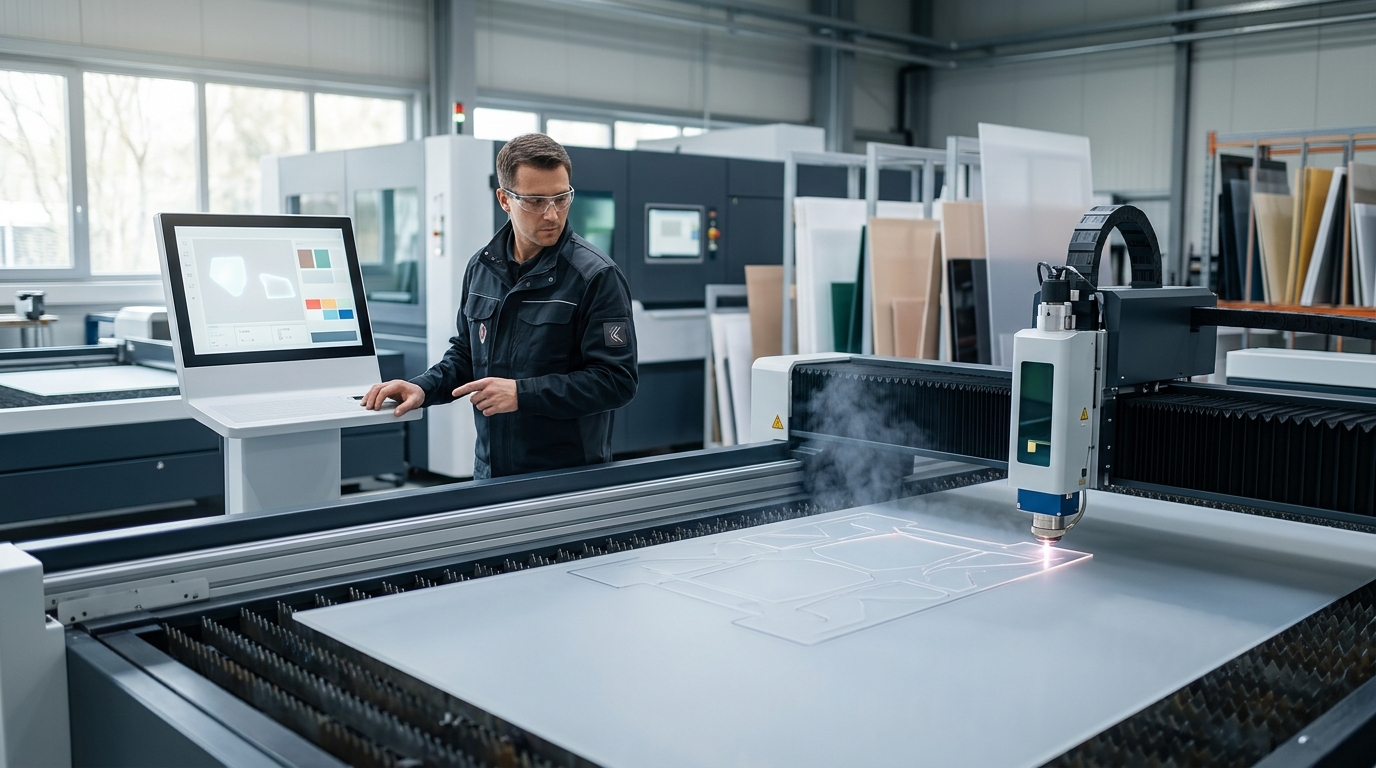
Industrial manufacturing of large-format acrylic components demands a shift from manual fabrication to automated laser systems. According to recent industry analyses, automated laser cutting can reduce material waste by up to 20% while increasing throughput for complex geometries. This guide details the specific hardware, software, and operational protocols required to achieve this level of efficiency.
Understanding Large Format Laser Technology
Large format laser cutting refers to the use of high-power laser sources to process materials exceeding standard desktop dimensions. For acrylic, this typically involves Carbon Dioxide (CO2) laser technology. CO2 lasers are the industry standard for non-metallic materials because their wavelength is perfectly absorbed by organic compounds like polymers.
When scaling up, the primary challenge is maintaining beam quality across a larger working area. OptiFlex systems are engineered to address this by providing a stable optical path that ensures consistent cut quality from the center to the edges of large sheets. This consistency is critical for projects requiring tight tolerances across multiple panels.
Automation in this context involves more than just the laser source. It includes automated focus adjustment, intelligent power modulation, and integrated camera systems for alignment. These features reduce the need for manual intervention, allowing for unattended operation during long production runs.
Selecting the Right Hardware for Acrylic
Choosing the correct laser system depends on the specific requirements of your acrylic projects. The material thickness, sheet size, and desired edge quality dictate the necessary hardware specifications.
CO2 vs. Fiber Laser Sources
Acrylic is a non-metallic material. Therefore, CO2 lasers are the appropriate choice. Fiber lasers, while excellent for metals, do not interact effectively with acrylic. The laser cutting process for acrylic relies on the rapid heating and vaporization of the material, which CO2 lasers achieve with high efficiency.
Enclosed vs. Open Bed Systems
For large-scale production, safety and environmental control are paramount. Enclosed systems like LaserCell provide a safe environment for operators while managing fumes and heat. Open bed systems offer easier access for loading large sheets but require robust ventilation solutions.
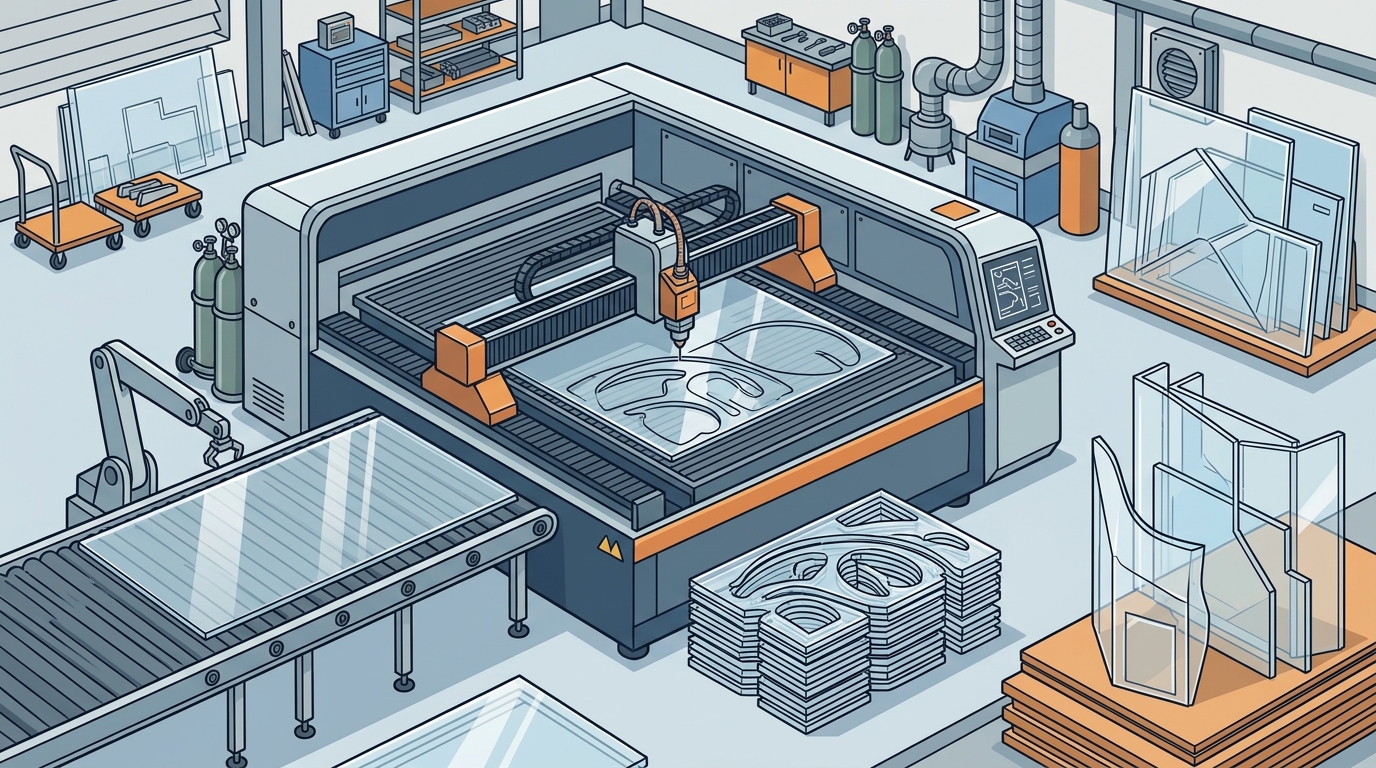
Table Size and Capacity
Large format projects often require cutting full 4x8 foot or 5x10 foot sheets. Ensure the selected system has a working area that matches your material inventory. Kern Laser Systems offers the OptiFlex series, which is designed specifically for large-format applications, providing a robust frame to minimize vibration during high-speed cutting.
Software Integration and Workflow
Hardware is only half of the automation equation. The software stack must support seamless file import, nesting, and machine control. KCAM Laser Software is a critical component of this workflow, offering advanced features for managing complex acrylic designs.
Nesting for Material Efficiency
Nesting is the process of arranging multiple parts on a sheet to minimize waste. Advanced nesting algorithms can optimize layout automatically, increasing material utilization by up to 15%. This is particularly important for large-scale projects where material costs are significant.
Automated Focus and Power Control
KCAM software integrates with the laser hardware to automate focus height and power settings based on material thickness. This ensures that each cut is optimized for the specific layer of acrylic, reducing the need for manual parameter adjustments.
Camera Alignment Systems
For projects requiring precise alignment with pre-printed or pre-cut acrylic, integrated camera systems are essential. The K-Vision Camera allows for real-time visual feedback, enabling the machine to adjust its cutting path to match the physical material position. This feature is crucial for multi-step processes involving registration marks.
Operational Best Practices for Acrylic
Achieving high-quality cuts in large-scale acrylic projects requires adherence to specific operational protocols. These practices ensure consistency, safety, and longevity of the equipment.
Material Preparation
Ensure that acrylic sheets are clean and free of dust or debris before loading. Contaminants can cause uneven cutting or damage the laser lens. Use compressed air or a soft cloth to prepare the surface.
Parameter Optimization
Different types of acrylic (cast vs. extruded) require different cutting parameters. Cast acrylic generally produces a clearer edge, while extruded acrylic may require adjusted power and speed settings. Conduct test cuts to determine the optimal parameters for your specific material batch.
Maintenance and Calibration
Regular maintenance is essential for maintaining precision. Clean the optical components regularly and check the alignment of the laser beam. Technical support resources are available to guide you through calibration procedures.
Comparison of Cutting Systems
Selecting the right system involves comparing features, capacity, and cost. The table below outlines the key differences between popular large-format laser systems.
| System Name | Primary Use Case | Key Feature | Best For |
|---|---|---|---|
| OptiFlex | Large Format Cutting | High Power CO2 Source | Complex geometries in thick acrylic |
| LaserCell | Enclosed Safety | Safety Enclosure | High-volume production environments |
| EcoFlex | Economical Large Format | Cost-Effective Design | Small to medium businesses |
| Micro | Small Format Precision | Compact Footprint | Detailed engraving and small parts |
Key Takeaways
- CO2 lasers are the standard for acrylic cutting due to their wavelength compatibility with organic materials.
- Large format systems like OptiFlex provide the necessary stability and power for industrial-scale projects.
- Software integration with KCAM enables automated nesting and focus control, reducing manual labor.
- Camera alignment systems like K-Vision ensure precision in multi-step manufacturing processes.
- Regular maintenance and parameter optimization are critical for maintaining cut quality and equipment longevity.
- Enclosed systems offer enhanced safety and fume management for high-volume production environments.
Frequently Asked Questions
What is the difference between cast and extruded acrylic for laser cutting?
Cast acrylic produces a clearer, more polished edge when laser cut, making it ideal for high-end displays. Extruded acrylic is generally less expensive but may require different power settings to achieve similar results.
How does automation improve large-scale acrylic production?
Automation reduces human error, increases throughput, and allows for unattended operation. Features like automated focus and nesting optimize material usage and cut speed.
Is it safe to cut acrylic without an enclosure?
While possible, cutting acrylic without an enclosure requires robust ventilation to manage fumes. Enclosed systems like LaserCell provide a safer and more controlled environment.
What software is recommended for large format laser cutting?
KCAM Laser Software is recommended for its advanced nesting capabilities and seamless integration with Kern Laser hardware.
How often should laser optics be cleaned?
Optics should be cleaned regularly, depending on usage. Daily cleaning is recommended for high-volume production to maintain cut quality and prevent damage.
Can I cut thick acrylic with a standard CO2 laser?
Yes, but thicker materials require higher power lasers and slower cutting speeds. Systems like OptiFlex are designed to handle thicker materials efficiently.
What is the role of the K-Vision Camera?
The K-Vision Camera provides real-time visual feedback, allowing for precise alignment and adjustment of the cutting path based on the physical material position.
Contact Us
Ready to automate your large-scale acrylic production? Contact our team of experts to discuss your specific needs and find the perfect laser system for your business. Visit our contact page to request a quote or schedule a consultation.