
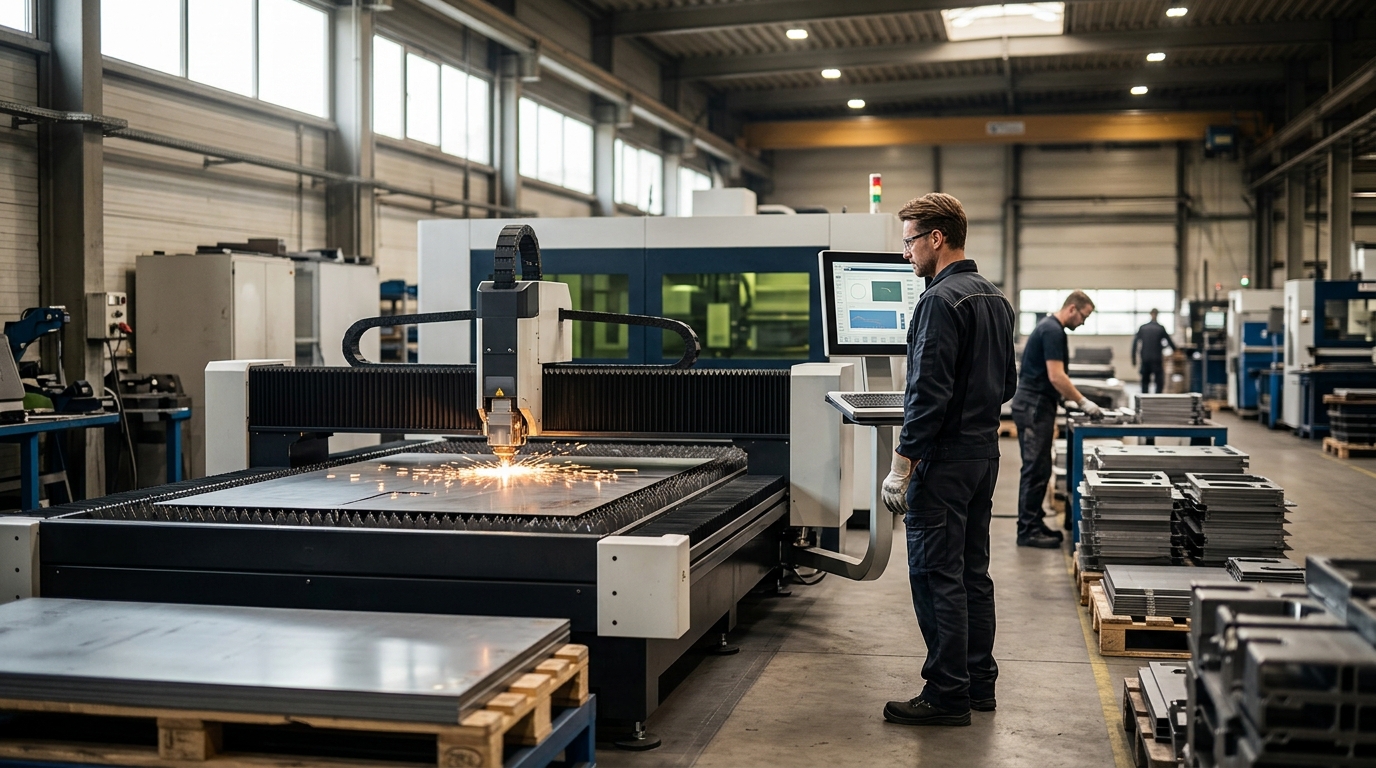
For high-volume production, a high-wattage fiber laser system is generally the best choice for metal fabrication, while a dual-laser CO2 system is optimal for mixed-material throughput. Kern Lasers provides both the FiberCELL for dedicated metal work and the OptiDual for high-speed, multi-material production. This guide covers the technical specifications, automation capabilities, and operational benefits of these systems to help you select the right equipment for your facility.
Fiber Laser Systems for Metal Fabrication
When the primary goal is cutting thick or reflective metals at high speed, a fiber laser is the industry standard. A fiber laser is a laser source that uses a doped glass fiber as its gain medium to produce a highly concentrated beam. This technology is particularly effective for materials like stainless steel, mild steel, aluminum, brass, and copper. The wavelength of a fiber laser is easily absorbed by these metals, allowing for faster piercing and cutting speeds compared to traditional CO2 sources.
Performance and Precision
Kern Lasers offers the FiberCELL, a compact sheet metal fabricating system designed for high-performance environments. This system is available in 1kW, 2kW, and 3kW configurations, providing the power necessary to handle thicker gauges of metal. The FiberCELL features a Class 2 safety enclosure, which allows it to be placed in high-traffic areas such as busy factory floors without the need for external interlocks or protective barriers. This design choice is critical for high-volume shops where floor space is at a premium and multiple operators may need to access the machine simultaneously.
The precision of the FiberCELL is defined by its positioning accuracy of +/- 0.001 inches and a repeatability of +/- 0.0005 inches. These specifications ensure that every part produced is identical to the last, which is a non-negotiable requirement for high-volume manufacturing. The system includes a pull-out table and an integrated parts collection drawer, features that streamline the workflow by reducing the time operators spend moving materials in and out of the machine.
Material Versatility in Metal
While fiber lasers are specialized for metal, they are not limited to a single alloy. The FiberCELL can cut and mark a wide variety of metals, including anodized aluminum and various grades of steel. For applications involving copper, which is highly reflective and difficult to process with lower-wattage CO2 lasers, the fiber source provides the necessary energy density to pierce and cut the material efficiently. This versatility allows a single machine to handle a diverse portfolio of metal products, from architectural panels to electrical components.
Industrial Automation Integration
High-volume production is not just about the speed of the laser beam; it is about the efficiency of the entire production line. Industrial automation integration is the process of connecting laser cutting systems with software, motion controls, and material handling equipment to create a seamless workflow. At Kern Lasers, this integration is centered around the KCAM software and advanced motion packages that allow for continuous, unattended operation.
The OptiDual for Continuous Production
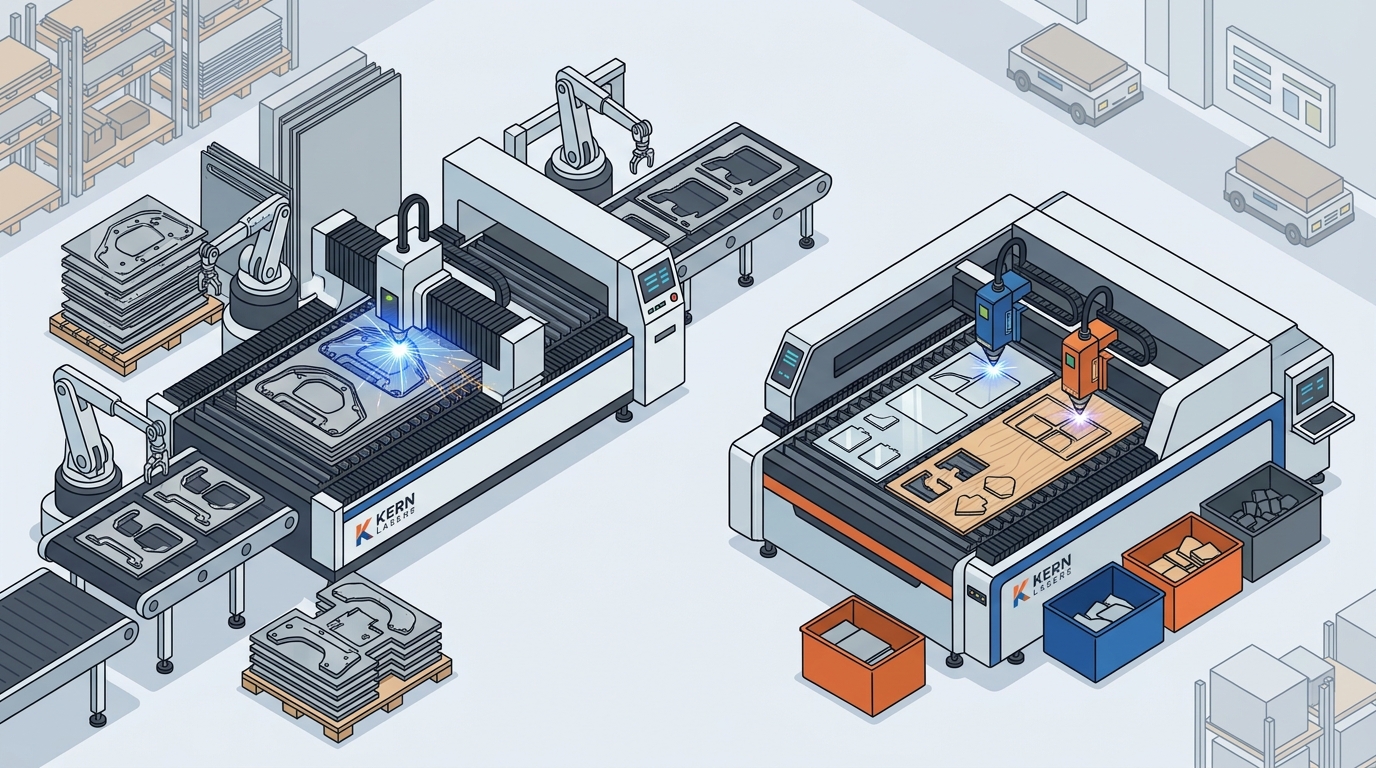
For facilities that require maximum throughput across multiple materials, the OptiDual is a specialized high-production laser cutting system. The OptiDual features two lasers mounted on a single gantry. As the master laser cuts a part, the second laser cuts the same part just inches away. This dual-laser configuration effectively doubles the production capacity without requiring a second machine or a second operator. Both lasers can have their output power matched within the KCAM software, ensuring that the parts being produced are similar in size, accuracy, and quality.
The OptiDual is powered by the HyperDual motion package, which includes high-speed servo motors on each side of the table in a rack and pinion setup. The X axis utilizes a linear motor and two precision rails, resulting in fast, accurate, and smooth cutting performance. This motion system is designed to handle the rapid acceleration and deceleration required for high-volume vector cutting, minimizing the time spent on non-cutting moves.
Software-Driven Workflow Optimization
The KCAM software is the brain of the automation process. It is a laser cutting and engraving software package developed by Kern’s in-house team. KCAM includes a built-in time estimator that automatically calculates the run time of the file loaded into the system. This feature is invaluable for quoting jobs and scheduling production runs. Additionally, the software supports multiple vector layers with independently set parameters, allowing operators to enable or disable specific colors with a single check of a box. This level of control ensures that complex files can be processed with the correct settings for each layer, reducing the risk of errors in high-volume batches.
Automation also extends to the physical handling of materials. Kern’s systems are equipped with vacuum hold-down tables that keep sheets flat while being processed. For materials like foam, the vacuum system is essential to prevent the material from shifting during the cut. The blower system integrated into the machine removes fumes released during laser processing, maintaining a clean and safe working environment. These features work together to create a production line that is both efficient and safe.
Key Takeaways
- Fiber lasers are the preferred choice for high-volume metal fabrication due to their high absorption rates and cutting speeds.
- The FiberCELL offers 1kW to 3kW power options and a Class 2 safety enclosure for safe placement in busy factory floors.
- The OptiDual system features two lasers on a single gantry, effectively doubling production capacity for mixed-material shops.
- KCAM software provides automation features like time estimation and multi-layer control to streamline high-volume workflows.
- Advanced motion packages like the HyperDual ensure fast and accurate cutting performance with high-speed servo motors.
- Positioning accuracy of +/- 0.001 inches is critical for maintaining consistency in high-volume production runs.
- Vacuum hold-down and blower systems are essential for maintaining material stability and a clean working environment.
- Choosing the right system depends on whether your primary material is metal (fiber) or a mix of materials (dual CO2).
Frequently Asked Questions
What is the difference between a fiber laser and a CO2 laser for production?
A fiber laser is optimized for cutting metals, particularly thick and reflective materials, due to its wavelength. A CO2 laser is more versatile, capable of cutting metals, wood, acrylic, and textiles. For high-volume metal production, fiber is generally faster and more efficient.
How does the OptiDual system increase production capacity?
The OptiDual uses two lasers on a single gantry. While one laser cuts a part, the second laser cuts the same part simultaneously. This allows the machine to produce two parts in the time it would normally take to produce one, effectively doubling throughput.
Is the FiberCELL safe for high-traffic factory floors?
Yes. The FiberCELL is a Class 2 enclosed system. It features special polycarbonate windows that filter harmful laser wavelengths, allowing it to be placed in busy areas without the need for external safety barriers or interlocks.
What software is used to control Kern laser systems?
Kern systems use KCAM software, which is developed in-house. It includes features like time estimation, multi-layer control, and cut optimization to help manage high-volume production workflows.
Can a CO2 laser cut thick metal?
CO2 lasers can cut thin-gauge metals like mild steel and aluminum. However, for thicker metals, such as 1/4 inch aluminum, a high-powered fiber laser is required. CO2 lasers are not typically used for thick metal fabrication.
What is the positioning accuracy of the FiberCELL?
The FiberCELL has a positioning accuracy of +/- 0.001 inches and a repeatability of +/- 0.0005 inches. This high level of precision ensures that parts are consistent across large production runs.
How does automation help with material handling?
Automation features like vacuum hold-down tables keep materials flat during cutting. Blower systems remove fumes, and pull-out tables make it easier to load and unload parts. These features reduce manual handling and increase overall efficiency.
What materials can the OptiDual process?
The OptiDual can cut and mark a wide range of materials, including acrylic, mild steel, stainless steel, aluminum, brass, wood, foam, leather, and stone. This versatility makes it ideal for shops that work with multiple material types.
Conclusion
Selecting the right laser cutting system for high-volume production requires a careful analysis of your primary materials and production goals. If your focus is on metal fabrication, the FiberCELL provides the power and precision needed for efficient metal cutting. For shops that require versatility and maximum throughput across multiple materials, the OptiDual offers a unique dual-laser solution that doubles production capacity. Both systems are supported by the KCAM software, which ensures that your workflow is optimized for speed and accuracy. To determine the best fit for your facility, contact Kern Lasers to discuss your specific production needs.