
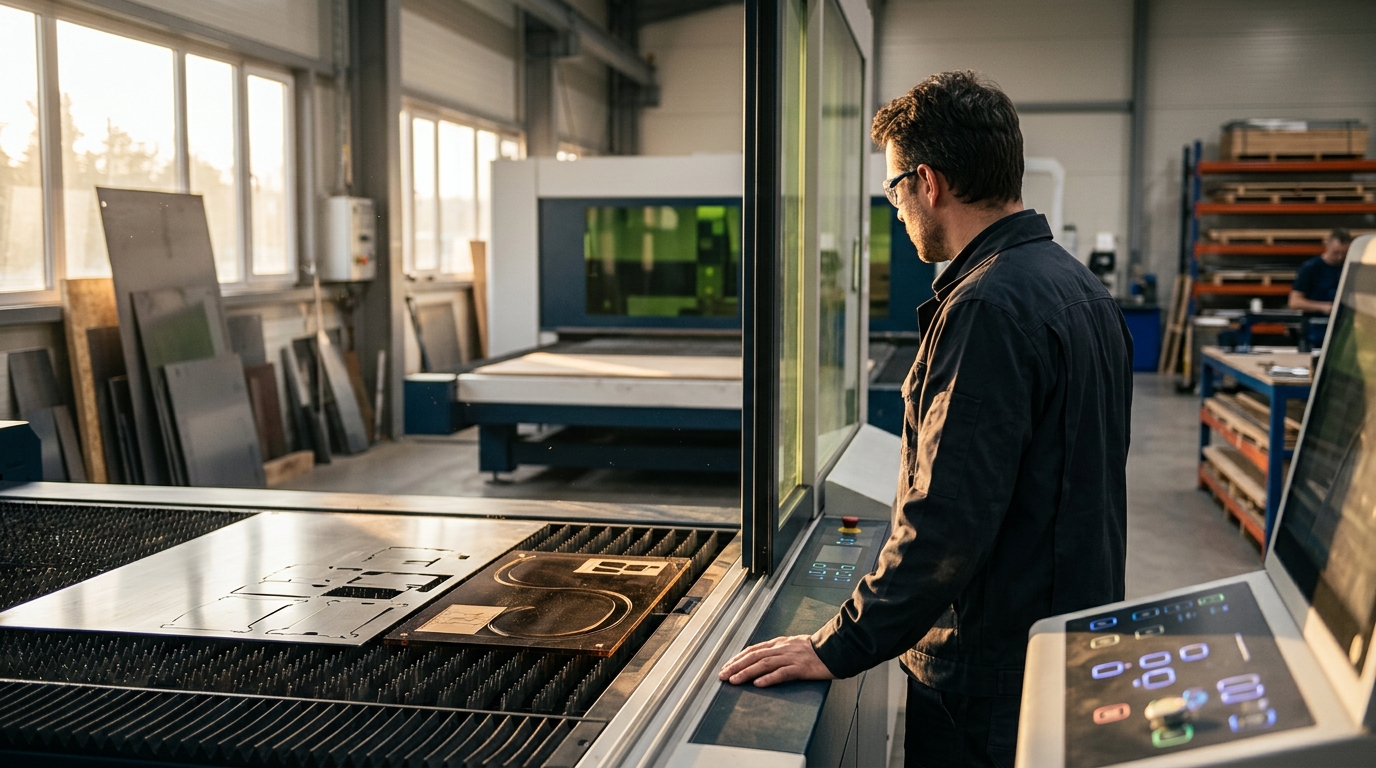
Choosing between CO2 and fiber laser cutting machines depends primarily on your target materials and production goals. Fiber lasers excel at high-speed metal fabrication, while CO2 lasers offer superior versatility for mixed-material environments. This guide provides a detailed breakdown of edge quality, maintenance, and operational costs to help you make the right capital investment decision.
Fundamental Differences in Technology
Understanding the core mechanics of each system is the first step in making an informed decision. CO2 lasers are gas lasers that use a mixture of carbon dioxide, nitrogen, and helium to generate a beam. This beam is typically directed via a series of mirrors and lenses to the workpiece. In contrast, fiber lasers are solid-state lasers that use doped optical fibers to amplify the beam. This fundamental difference dictates their performance characteristics and ideal use cases.
The beam quality of a fiber laser is generally superior. It can be focused to a much smaller spot size, allowing for finer detail and faster cutting speeds on thin to medium metals. CO2 lasers, while powerful, have a larger spot size and require more complex optical paths. This complexity can lead to higher maintenance needs over time. At Kern Laser Systems, we have long recognized the value of offering both technologies to serve the diverse needs of our customers.
Edge Quality and Cut Precision
Edge quality is a critical factor in determining the final value of a laser-cut part. The quality of the cut edge affects the need for post-processing, such as deburring or polishing, which directly impacts production costs and lead times.
CO2 Laser Edge Characteristics
CO2 lasers produce a cut edge that is generally smooth on non-metallic materials like wood, acrylic, and textiles. When cutting light-gauge metals, the edge quality is acceptable for many applications, though it may require some finishing. The larger beam diameter of a CO2 laser can result in a slightly wider kerf, which is the width of the material removed by the cut. This is a trade-off for the versatility the technology offers.
Fiber Laser Edge Characteristics
Fiber lasers are renowned for their exceptional edge quality on metals. The smaller spot size and higher power density allow for a cleaner, more precise cut with a narrower kerf. This results in less material waste and often eliminates the need for extensive post-processing. For high-volume metal fabrication, the superior edge quality of fiber lasers is a significant advantage.
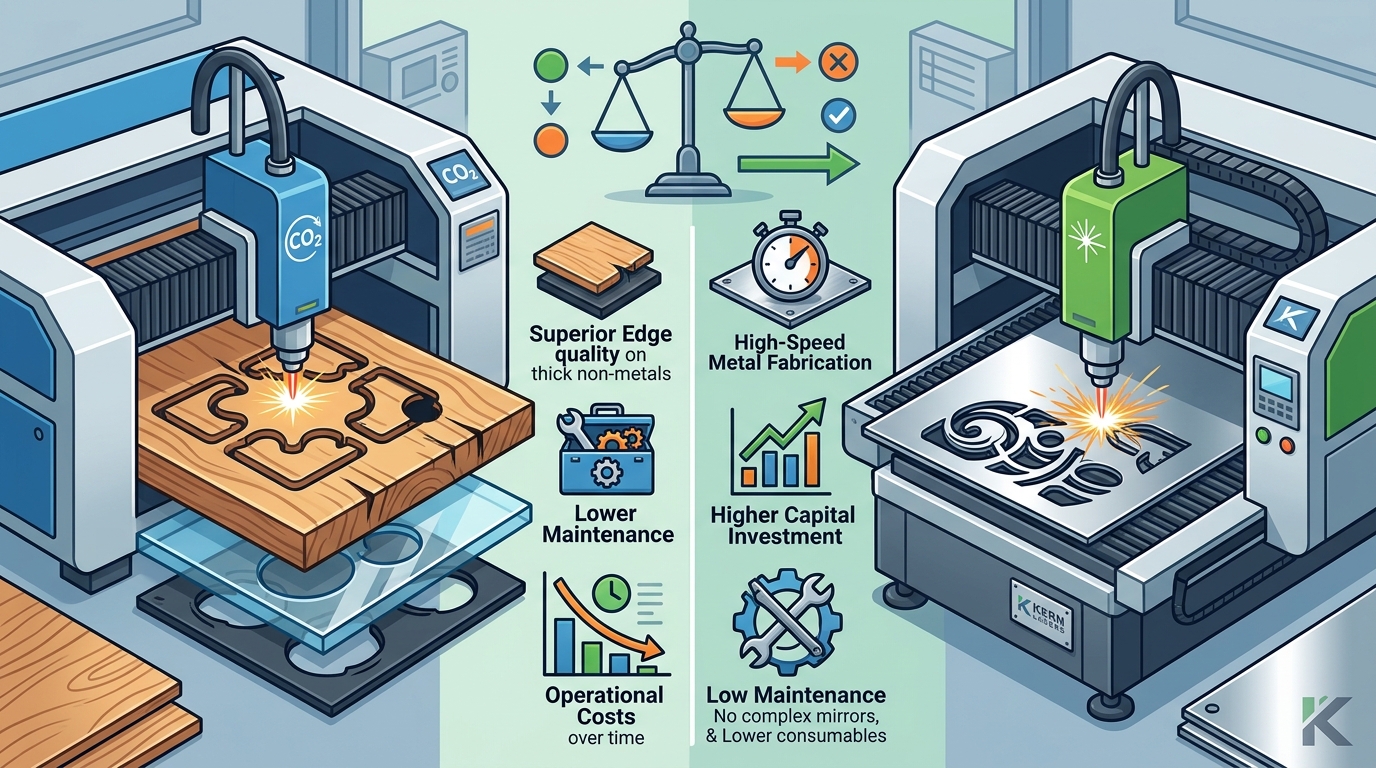
Maintenance Requirements and Operational Costs
Maintenance is a major consideration in the total cost of ownership of a laser cutting machine. The complexity of the optical path and the type of laser source directly influence the time and cost associated with upkeep.
CO2 Laser Maintenance
CO2 lasers require regular maintenance of their optical components. The mirrors and lenses that direct the beam can become dirty or misaligned, which degrades beam quality and cutting performance. Operators must regularly clean these components and ensure they are properly aligned. Additionally, the gas mixture in the laser tube needs to be monitored and replenished as needed. The laser tube itself has a finite lifespan and will eventually need to be replaced.
Fiber Laser Maintenance
Fiber lasers are significantly easier to maintain than their CO2 counterparts. The beam is transmitted through a fiber optic cable, which eliminates the need for a complex mirror and lens system. This results in fewer components that can fail or require cleaning. Fiber lasers also have a longer lifespan and do not require gas replenishment. The primary maintenance tasks involve cleaning the cutting head and ensuring the cooling system is functioning properly.
Material Compatibility and Versatility
The range of materials a laser can process is a key differentiator between CO2 and fiber technologies. Your choice should be driven by the specific materials you need to cut and engrave.
CO2 Laser Versatility
CO2 lasers are highly versatile and can cut and engrave a wide variety of materials. They are the go-to choice for non-metallic materials such as wood, acrylic, leather, glass, and textiles. They can also cut light-gauge metals, making them a suitable option for businesses that work with a mix of materials. This versatility makes CO2 lasers an excellent choice for sign shops, prototyping labs, and educational institutions.
Fiber Laser Specialization
Fiber lasers are optimized for metal cutting. They are highly efficient at cutting a wide range of metals, including mild steel, stainless steel, aluminum, brass, and copper. However, they are not suitable for cutting non-metallic materials. If your business is focused exclusively on metal fabrication, a fiber laser is the ideal choice. For more information on metal cutting, visit our sheet metal laser cutter page.
CO2 vs Fiber Laser Comparison Table
| Feature | CO2 Laser | Fiber Laser |
|---|---|---|
| Primary Use | Non-metals and light-gauge metals | Metals |
| Beam Quality | Good | Excellent |
| Edge Quality on Metals | Good | Excellent |
| Maintenance | High (mirrors, lenses, gas) | Low (fiber optic) |
| Versatility | High | Low (metals only) |
| Energy Efficiency | Lower | Higher |
Key Takeaways
- Fiber lasers are superior for high-speed metal cutting with excellent edge quality.
- CO2 lasers offer greater versatility, capable of processing both metals and non-metals.
- Fiber lasers require significantly less maintenance than CO2 lasers.
- CO2 lasers have a more complex optical path, requiring regular cleaning and alignment.
- The choice between CO2 and fiber should be driven by your primary materials and production goals.
- Fiber lasers are more energy efficient, leading to lower operating costs.
- CO2 lasers are a better fit for businesses that need to work with a wide variety of materials.
Frequently Asked Questions
Can a CO2 laser cut metal?
Yes, CO2 lasers can cut light-gauge sheet metal. However, they are not as efficient or fast as fiber lasers for this application. For more details, see our guide on will a CO2 laser cut metal.
What is the main advantage of a fiber laser?
The main advantage of a fiber laser is its superior beam quality and efficiency for cutting metals. This results in faster cutting speeds and cleaner edges.
Which laser is better for cutting wood?
CO2 lasers are the standard for cutting and engraving wood. Fiber lasers are not suitable for processing wood or other non-metallic materials.
How much more does a fiber laser cost than a CO2 laser?
Fiber lasers are generally more expensive upfront than CO2 lasers of a similar power rating. However, their lower maintenance and operating costs can lead to a lower total cost of ownership over time.
Can I use a fiber laser for engraving?
Yes, fiber lasers are excellent for marking and engraving metals. They can create high-contrast marks on a variety of metal surfaces.
What is the lifespan of a CO2 laser tube?
The lifespan of a CO2 laser tube varies depending on usage and maintenance, but it typically lasts several years. Fiber lasers have a significantly longer lifespan.
Conclusion
Choosing between a CO2 and fiber laser cutting machine is a significant decision that will impact your business for years to come. By carefully considering your material requirements, production goals, and budget, you can select the technology that best fits your needs. For businesses that require the versatility to work with a wide range of materials, a CO2 laser is an excellent choice. For those focused on high-volume metal fabrication, a fiber laser is the superior option. Contact Kern Laser Systems to discuss your specific needs and find the right laser solution for your business.