

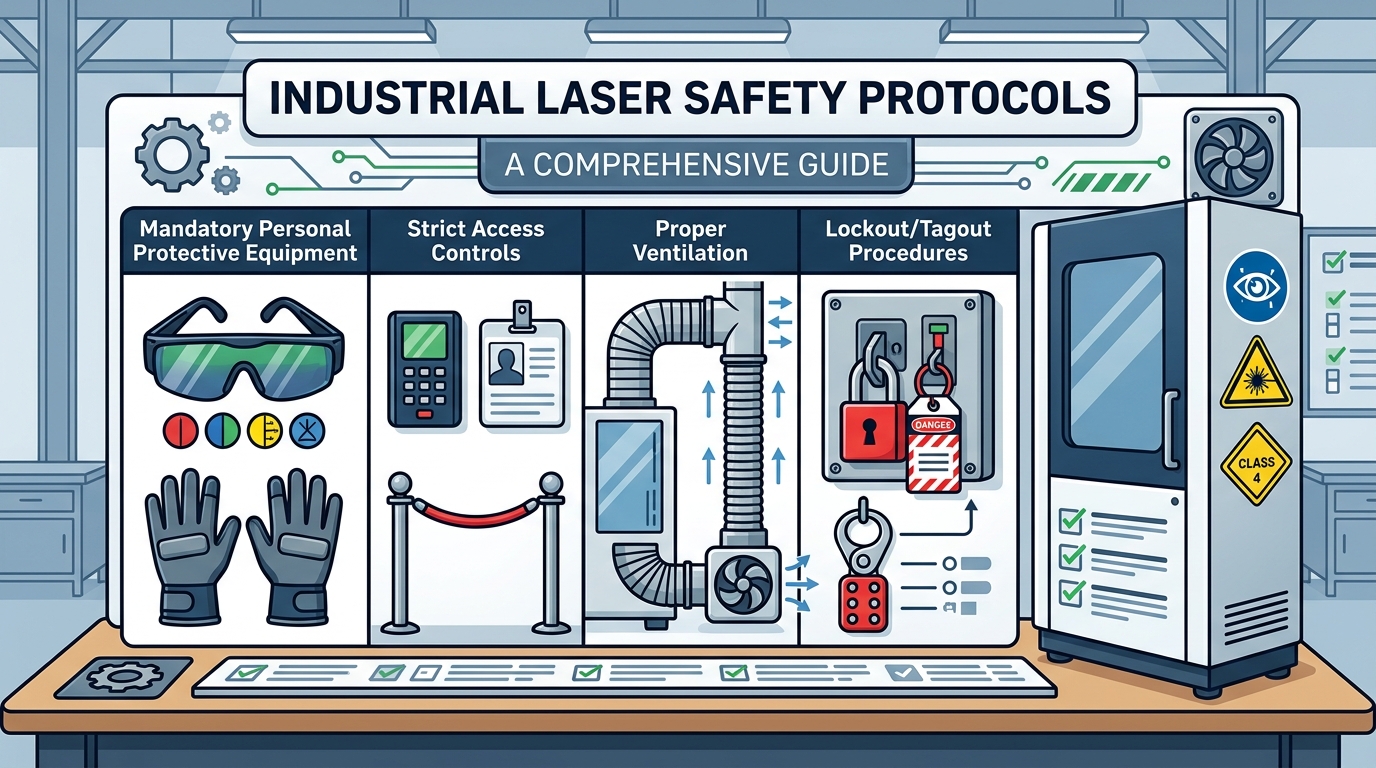
Industrial laser safety protocols are necessary to prevent severe eye and skin injuries, fires, and equipment damage. These protocols include strict access controls, proper ventilation, and mandatory personal protective equipment. This guide covers the essential safety measures required for operating industrial laser equipment, focusing on lockout/tagout procedures and compliance with industry standards.
Lockout/Tagout Procedures
Lockout/tagout (LOTO) is a critical safety procedure used to ensure that dangerous machines are properly shut off and not able to be started up again prior to completing maintenance or clearing a jam. In the context of industrial laser equipment, LOTO is essential for protecting technicians and operators from unexpected energization of the laser source or motion systems. Kern Laser Systems emphasizes that creating a safe and healthy working environment is a top priority when implementing any piece of industrial machinery. Their engineers have invested thousands of hours ensuring their equipment meets or exceeds all required safety standards put forth by CDRH, UL, CE, and ANSI.
Implementing LOTO for Laser Systems
When performing maintenance on a laser system, such as replacing a focusing lens or cleaning the beam path, the laser source must be isolated from its power supply. This involves applying a lockout device to the main electrical disconnect switch. A tag must also be attached to the lockout device, identifying the person who applied it and the reason for the lockout. This prevents other personnel from accidentally restarting the machine. For systems with multiple energy sources, such as pneumatic actuators or compressed gas supplies, each source must be isolated and locked out individually.
Verification of Zero Energy State
After applying lockout devices, the technician must verify that the machine is in a zero energy state. This is done by attempting to start the machine using the normal start controls. If the machine does not start, the lockout is effective. The technician should also check for any stored energy, such as capacitors in the laser power supply or tension in the motion belts, and ensure that this energy is safely dissipated or blocked. Only after verification can the technician begin work on the machine. Upon completion of the maintenance, the technician must remove the lockout device, notify all affected personnel, and restore the machine to service.
Laser Classifications and Hazard Levels
Laser classification is a system used to categorize laser products based on their potential to cause injury. The classification is determined by factors such as laser output energy (watts) and wavelength. Understanding these classifications is fundamental to implementing appropriate safety controls. Kern’s laser systems fall into one of two classifications: Class 2 or Class 4. Generally, the lower the classification, the safer the device is. However, when safety protocols are followed along with the many safety features implemented into the machines, all systems can be safely operated.
Class 2 Lasers
Class 2 lasers are low-power visible light lasers. The natural aversion response of the human eye, which causes the eye to look away or blink, provides adequate protection against injury from brief exposures. These lasers are typically found in applications such as barcode scanners and presentation pointers. In industrial settings, Class 2 lasers are often used in enclosed systems where the beam is not accessible to the operator.
Class 4 Lasers
Class 4 lasers are high-power lasers that can cause severe eye and skin injuries, as well as fires, from direct or diffuse reflections. These lasers require strict safety controls, including interlocked enclosures, warning labels, and restricted access areas. A Laser Safety Officer (LSO) must be appointed for companies operating a Class 4 laser system. The LSO has the responsibility to monitor the safe usage of lasers in a work environment by defining the proper control measures according to the different levels of laser hazards. Common control measures may include assigning proper laser safety glasses, warning labels/signage, and implementing safe operational procedures.
Built-in Safety Features
Modern industrial laser systems are equipped with a variety of built-in safety features designed to protect operators and the surrounding environment. These features work in conjunction with operational protocols to create a comprehensive safety system. Kern’s engineers have invested significant time in developing these features to ensure compliance with international safety standards.
Interlocks and Enclosures
Many laser systems, such as the LaserCELL and FiberCELL, feature safety enclosures with interlocked doors. These interlocks automatically shut off the laser beam if a door is opened during operation. This prevents accidental exposure to the high-power beam. The enclosures also help contain fumes and debris generated during the cutting or engraving process. For open-frame systems, such as the OptiFlex, additional safety measures, such as beam curtains or protective eyewear, are required to protect operators from direct and diffuse reflections.
Emergency Stop and Fume Extraction
All industrial laser systems are equipped with emergency stop buttons that immediately shut down the laser and motion systems. These buttons should be easily accessible to the operator at all times. Fume extraction systems are also critical for maintaining a safe working environment. These systems remove hazardous fumes and particulates generated during laser processing. Proper ventilation is essential to prevent the accumulation of toxic gases and to reduce the risk of fire.
Operational Safety Protocols
Operational safety protocols are the day-to-day procedures that operators must follow to ensure safe laser use. These protocols include pre-operation checks, proper material handling, and post-operation cleanup. Adhering to these protocols is essential for preventing accidents and maintaining a safe workplace.
Pre-Operation Checks
Before starting a laser job, the operator should perform a pre-operation check. This includes inspecting the laser system for any signs of damage or wear, checking the condition of the safety interlocks, and ensuring that the fume extraction system is functioning properly. The operator should also verify that the material to be processed is compatible with the laser and that the appropriate settings have been selected. Any issues identified during the pre-operation check should be reported to a supervisor before proceeding.
Material Handling and PPE
Operators must wear appropriate personal protective equipment (PPE) when working with laser systems. This typically includes laser safety glasses with the appropriate optical density for the laser wavelength and power. The type of PPE required depends on the laser classification and the specific task being performed. Operators should also wear closed-toe shoes and avoid loose clothing or jewelry that could get caught in the machine. Proper material handling is also important to prevent accidents. Materials should be securely clamped or held in place to prevent movement during processing. Flammable materials should be kept away from the laser beam and any hot surfaces.
The Role of the Laser Safety Officer
The Laser Safety Officer (LSO) is a designated individual responsible for ensuring that laser safety protocols are followed in the workplace. The LSO has the authority to stop laser operations if a safety hazard is identified. The LSO is also responsible for conducting laser safety training for all personnel who work with laser systems. This training should cover the basics of laser safety, the specific hazards associated with the laser systems in use, and the proper use of PPE and safety equipment.
LSO Responsibilities
The LSO is responsible for developing and implementing a laser safety program for the organization. This program should include written safety procedures, hazard assessments, and training records. The LSO should also conduct regular inspections of the laser systems and the work environment to ensure that safety controls are in place and functioning properly. The Laser Institute of America (LIA) offers in-person and online courses which are well suited for those looking to become an LSO. For more information, please visit the LIA training web page. The LSO should stay up-to-date on the latest laser safety standards and regulations to ensure that the organization remains compliant.
Key Takeaways
- Lockout/tagout (LOTO) is a critical safety procedure for isolating energy sources during maintenance.
- Laser classification determines the level of hazard and the required safety controls.
- Class 4 lasers require strict safety controls, including interlocked enclosures and restricted access.
- Built-in safety features, such as interlocks and fume extraction, are essential for safe operation.
- Operators must follow operational safety protocols, including pre-operation checks and proper PPE use.
- A designated Laser Safety Officer (LSO) is responsible for overseeing laser safety in the workplace.
- Regular training and inspections are necessary to maintain a safe laser work environment.
- Compliance with standards from CDRH, UL, CE, and ANSI is mandatory for industrial laser equipment.
Frequently Asked Questions
What is the primary purpose of lockout/tagout in laser maintenance?
The primary purpose of lockout/tagout is to ensure that the laser system is properly shut off and cannot be restarted during maintenance, protecting technicians from unexpected energization.
Which laser classification requires a designated Laser Safety Officer?
Class 4 lasers require a designated Laser Safety Officer to monitor safe usage and define control measures.
What are the main built-in safety features of modern laser systems?
Main built-in safety features include interlocked enclosures, emergency stop buttons, and fume extraction systems.
Why is fume extraction important in laser processing?
Fume extraction is important to remove hazardous fumes and particulates, preventing the accumulation of toxic gases and reducing fire risk.
What personal protective equipment (PPE) is required for laser operation?
Required PPE typically includes laser safety glasses with the appropriate optical density, closed-toe shoes, and avoidance of loose clothing.
Who is responsible for laser safety training in the workplace?
The Laser Safety Officer (LSO) is responsible for conducting laser safety training for all personnel who work with laser systems.
What standards must industrial laser equipment meet?
Industrial laser equipment must meet or exceed safety standards put forth by CDRH, UL, CE, and ANSI.
How can operators verify that a laser system is in a zero energy state?
Operators can verify a zero energy state by attempting to start the machine using normal controls and checking for stored energy in capacitors or motion systems.